Go Doodling: A Practical Guide to Clearer Thinking and Better Communication
You have probably found yourself doodling during a long meeting or while listening to a lecture. Those seemingly random sketches on the corner of your notebook often get dismissed as a sign of distraction. But what if those marks could become a structured tool for sharper thinking and clearer communication? That is the idea behind Go Doodling, a purposeful approach to visual note-taking and idea generation that turns simple drawings into a practical thinking aid. Whether you are a marketer mapping out a campaign, a freelancer explaining a concept to a client, or an educator trying to make a point stick, Go Doodling offers a low-friction way to organise thoughts, spot connections, and communicate with greater clarity.
This approach is not about artistic skill. It relies on basic shapes, arrows, containers, and simple figures to capture and structure information visually. The value lies in the process itself. When you translate an abstract idea into a visual form, you engage different cognitive pathways than when you type or speak. You slow down just enough to consider relationships between concepts, and you create a reference that your brain can recall more easily later. For many adults juggling complex responsibilities, that combination of clarity, memory, and efficiency is exactly what daily workflow needs.
How Visual Thinking Changes the Way You Process Information
Most professional work relies heavily on text and numbers. Emails, reports, spreadsheets, and slide decks dominate the landscape. Yet human brains are wired for visual processing. Studies in cognitive psychology suggest that people remember images far longer than text, and that combining visual and verbal information improves comprehension. Go Doodling leverages this natural tendency by encouraging you to sketch relationships instead of just describing them.
Consider a typical planning session for a small business owner. You have goals, budget constraints, team responsibilities, and deadlines all floating in your mind. Writing them in a list helps, but it does not reveal how those elements interact. A simple Go Doodling sketch with circles for each priority, arrows showing dependencies, and a timeline drawn across the page can expose gaps or conflicts that a linear list would hide. The act of drawing forces you to decide what is central and what is peripheral. That alone simplifies decision-making and reduces the mental load of keeping everything in your head.
For creators and entrepreneurs who constantly generate new ideas, Go Doodling serves as a rapid prototyping tool. You can sketch a product concept, a user journey, or a content funnel in minutes. The rough nature of the drawing keeps you from getting attached to details too early. You iterate quickly, crossing out and redrawing as your thinking evolves. This low-stakes environment encourages experimentation and makes it easier to share half-formed ideas with collaborators without overcommitting to a polished version.
Stronger Communication with Less Effort
Explaining a complex process to a client or colleague often leads to misunderstandings. Words can be interpreted differently by different people. A Go Doodling sketch provides a shared visual reference that aligns everyone's understanding. If you draw a simple flowchart showing how a customer moves from awareness to purchase, each person in the room sees the same sequence. Questions surface immediately. Gaps become obvious. The conversation shifts from abstract discussion to concrete problem-solving.
Freelancers and consultants especially benefit from this. When you present a proposal or recommendation, including a hand-drawn diagram alongside your written explanation builds trust. It shows that you have thought through the logic, not just the wording. Clients often respond more positively to a visual because it feels accessible and transparent. They can point to a specific part of the drawing and ask clarifying questions, which leads to better outcomes and fewer revisions later.
Better Retention and Follow-Through
One of the most overlooked advantages of Go Doodling is how it supports memory. When you doodle key points during a meeting or while reading, you create a unique visual cue for each concept. Later, when you look back at the page, your brain can reconstruct the context around those marks. This is far more effective than scanning a page of linear notes where every line looks similar. For bloggers and educators who consume and synthesise large amounts of information, this retention boost translates directly into better content and more coherent lessons.
Moreover, the physical act of drawing keeps your hands occupied in a way that complements listening. Many people find that doodling during a webinar or presentation actually improves their focus rather than detracts from it. The key is that Go Doodling is structured enough to keep you engaged but not so demanding that it competes for attention with the speaker. You are not trying to produce a work of art. You are capturing the essence of what is being said in a form that makes sense to you.
Who Benefits Most and Why
While Go Doodling can help almost anyone who thinks visually, certain groups tend to gain the most from adopting the practice. Marketers and content creators often use it to map customer journeys, brainstorm campaign themes, or storyboard video scripts. The visual format helps them see the flow from one stage to the next and identify where the narrative weakens. Project managers and team leads use it to outline workflows, clarify roles, and document processes without spending hours writing lengthy documentation. A single page drawing can replace a multi-page report when the goal is alignment rather than detail.
Educators and trainers find Go Doodling useful for explaining concepts that are inherently visual or sequential. A history timeline, a scientific process, or a business model canvas all become more teachable when drawn in real time with learners. The act of drawing together also creates a collaborative atmosphere where participants feel comfortable asking questions and adding their own ideas.
Entrepreneurs and small business owners often wear many hats and need tools that work across different contexts. Go Doodling fits this need because it requires no software, no setup, and no training. A notebook and a pen are enough. You can sketch out a new pricing model during a coffee break or visualise a hiring plan on the back of an envelope. The simplicity keeps the barrier to entry low, which means you are more likely to use it consistently.
When to Choose Go Doodling and When to Look Elsewhere
As practical as it is, Go Doodling is not the right tool for every situation. If you need to document highly detailed technical specifications or legal agreements, text-based notes or formal diagrams are more appropriate. The rough nature of doodling leaves room for ambiguity, which is useful for brainstorming but problematic for precise records. Similarly, if you are presenting to a large audience that expects polished visuals, a hand-drawn sketch might come across as unprofessional. In those cases, use Go Doodling in your preparation phase and then translate the key insights into cleaner graphics for the final deliverable.
Another consideration is personal style. Some people genuinely prefer linear, text-based thinking and find visual mapping distracting. Go Doodling works best as a complement to your existing workflow, not a replacement. Start small by using it for one specific task each week. For example, sketch the main points of your next team meeting agenda or draw the customer journey for a current project. See if the visual version helps you think more clearly or communicate more effectively. If it does, expand the practice from there.
Getting Started Without Overthinking
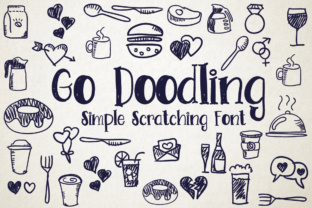
The biggest mistake newcomers make is worrying about quality. They hesitate because they think they cannot draw. Go Doodling explicitly rejects that concern. You only need five basic elements: circles, squares, lines, arrows, and stick figures. Everything else is optional. A circle can represent a concept, a person, a phase, or a goal. An arrow shows influence, sequence, or direction. A simple box groups related items. That is enough to represent most business or creative ideas.
To build the habit, keep a dedicated notebook where you sketch one idea per day. It might be a summary of a chapter you read, a map of a problem you are trying to solve, or a plan for the week. Over time, you will develop a personal visual vocabulary that feels natural and efficient. The goal is not to create beautiful drawings but to create useful ones. A useful drawing is one that helps you think or helps someone else understand. If it does that, it has done its job.
Long-Term Value Beyond the Page
What makes Go Doodling more than a passing trend is its adaptability. It works across industries, roles, and personal contexts. It requires no subscription, no internet connection, and no special skills. As AI tools and digital platforms evolve, the ability to think clearly and communicate simply becomes more valuable, not less. Visual thinking is a human skill that technology can support but cannot replace. By practising Go Doodling regularly, you build a cognitive habit that improves how you process information, collaborate with others, and make decisions.
If you have ever felt stuck trying to explain something or overwhelmed by too much information, try putting the pen to paper in a more intentional way. Let the shapes do some of the thinking for you. You might find that the clearest path forward is the one you drew yourself.